AI is entering the boardroom — but is Corporate governance ready?
Balancing Opportunities and Ethics
10/21/20253 min read
My post content
In today’s boardrooms, one truth has become undeniable — corporate governance is no longer just about compliance. It’s about building trust, ensuring resilience, and navigating complexity in a rapidly changing world.
Corporate governance has always evolved with societal expectations. From reforms after Enron to the growing focus on Environmental, Social, and Governance (ESG) principles, governance has proven remarkably adaptive. Now, we stand at another turning point: Artificial Intelligence (AI) — both a powerful disruptor and a transformative enabler of good governance.
The Promise: AI as a Strategic Asset
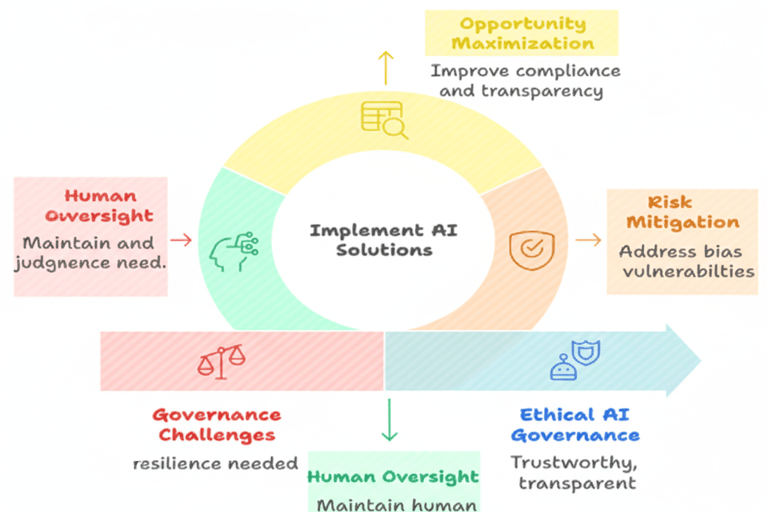
AI offers boards unprecedented tools to strengthen oversight and improve decision-making. No longer limited to hindsight analysis, boards can now anticipate risks, trends, and opportunities with far greater precision.
Fraud detection: AI systems can spot suspicious transactions in real time — patterns that human analysts might take weeks to uncover.
ESG reporting: Once a labour-intensive, error-prone process, it can now be automated for accuracy and transparency.
Stakeholder sentiment: AI can instantly synthesize thousands of investor or employee voices, revealing insights that help shape strategy.
Imagine board meetings where dashboards not only summarise the past but forecast the future — offering predictive analytics, scenario modelling, and early warnings. This shift from reactive to proactive oversight could redefine how boards fulfil their fiduciary duties.
The Peril: Navigating AI’s Inherent Risks
But with this power comes profound responsibility. The integration of AI into governance raises difficult questions that boards cannot ignore.
Bias and fairness: AI learns from historical data, which often contains embedded biases. If unchecked, these can reinforce inequities in risk, hiring, or compliance decisions.
Accountability: If an algorithm leads to a poor decision, who is responsible — the board, management, data scientists, or the vendor?
Cybersecurity: AI platforms need access to sensitive corporate data, creating new vulnerabilities and attractive targets for hackers.
Regulatory uncertainty: With AI laws evolving globally, boards face a moving target of compliance requirements.
Over-reliance: AI is brilliant at pattern recognition but lacks context, ethics, and judgment. Governance cannot and should not be fully automated.
The Foundation: Ethics as a Non-Negotiable
Corporate governance is, at its heart, a human endeavour grounded in accountability, transparency, and fairness. Any AI deployment must honour these principles.
Key ethical pillars include:
Fairness – Embed equity in design; audit systems for bias regularly.
Transparency – Avoid “black-box” algorithms; ensure explainable outcomes.
Data Privacy – Uphold strict data security and confidentiality.
Human Oversight – AI should enhance, not replace, human judgment.
Sustainability – Consider AI’s environmental footprint, from energy use to e-waste.
Simply put: AI should strengthen leadership & not supplant it.
The Reality: Where Boards Stand Today
While around 80% of companies now use AI in some form, its integration into formal governance processes remains limited. Still, progress is accelerating:
As of early 2024, only 15% of S&P 500 companies disclosed board-level AI oversight.
By late 2024, that number had nearly doubled to 28% — an 84% year-over-year increase. (corpgov.law.harvard.edu)
The AI governance solutions market— valued at $227 million in 2024 — is projected to grow to $1.4 billion by 2030 (CAGR: 35.7%).(grandviewresearch.com)
This data signals a pivotal moment: early experimentation is giving way to structured adoption, driven by regulation, stakeholder pressure, and the pursuit of competitive advantage.
The Path Forward: Responsible AI Integration
Boards must evolve from passive oversight to proactive stewardship. This requires not just new tools, but a new mindset.
Ask hard questions – Ensure AI aligns with corporate values and ethical standards.
Set clear principles – Establish and review AI ethics guidelines regularly.
Communicate openly – Be transparent about how AI influences governance decisions.
Stay informed – Prioritize board education to keep pace with fast-changing AI capabilities.
Engage stakeholders – Maintain dialogue with investors, employees, and communities to ensure alignment with expectations.
Conclusion: Governance That’s Not Just Smart — But Wise
We are at a defining moment. AI’s integration into governance isn’t just a technological step forward — it’s a chance to reimagine how boards lead.
The companies that thrive will embrace AI’s potential while staying anchored in timeless principles. They’ll use AI to see further, act faster, and lead better, without losing sight of the human purpose governance serves.
Ultimately, the most effective boards will blend innovation with integrity, ensuring decisions remain not only intelligent but also wise, fair, and accountable.
So, what’s your view?
Is corporate governance ready for AI’s arrival in your organisation?
#AIinGovernance #CorporateGovernance #BoardLeadership #EthicalAI #DigitalTransformation #FutureOfBoards #ResponsibleLeadership #TrustAndTransparency #ArtificialIntelligence