

Better to Be Legal Than Sorry
Compliance is not a cost — it’s an insurance for credibility, continuity, and corporate reputation.
1. Introduction – Why Law Is Required and Why It Matters
Laws are the invisible guardrails that allow progress to happen safely. They exist not to restrict us, but to protect us — to ensure fairness, accountability, and trust in the systems we build.
In the corporate world, compliance isn’t just about ticking boxes or avoiding penalties. It’s about aligning an organization’s actions with its values. When done right, compliance reflects integrity in motion.
In an era where brand reputation can collapse overnight with a single regulatory slip, being compliant isn’t an option — it’s survival. It’s always better to be legal than sorry.
2. Aspects of Compliance
Compliance today wears many faces — from genuine to cosmetic, from moral to mechanical. The difference between “doing what’s required” and “doing what’s right” defines the real character of an organization.
Let’s explore a few shades of compliance through real experiences:
a. Compliance in Letter This means following the law word by word — filing reports, maintaining registers, and meeting deadlines. It keeps regulators satisfied but often misses the spirit behind the law.
b. Compliance in Letter and Spirit
This is the gold standard. I once worked in an organization where every provision of law was debated and interpreted — not to find loopholes, but to understand intent. We even went back to Parliamentary debates to capture the true purpose of the legislation. That’s what genuine compliance looks like — not fear, but respect for the rule of law.
c. Paper Compliance
On the surface, everything looked flawless — registers neatly updated, notice boards shining, and files stacked with precision. The safety boards were impressive too, declaring in bold letters: “Wear goggles for welding,” “Helmets mandatory in restricted areas,” “Use safety belts while working at height.”
But behind this picture-perfect facade, reality told a different story — there were no goggles, no helmets, no safety belts provided.
The unwritten philosophy was clear: “Karo kuch bhi, likho barabar.”
(Do whatever you like, as long as the paperwork looks perfect.)
It was a painful reminder that compliance without conscience is a dangerous illusion.
d. Compliance Aimed at Avoiding Notices or Penalties
In some organizations, compliance exists only to avoid trouble — a reactive shield rather than a proactive principle. Local authorities often “advised” how to stay one step ahead of inspections. This short-term mindset creates long-term vulnerability.
e. Facade of Compliance
Creating the illusion of compliance can be more dangerous than defiance of the law. It’s a sophisticated form of deception — everything looks fine but hollow in practice.
In one organization, most employees were technically on contract, and there existed a “proper” tripartite settlement under the Industrial Disputes Act between the contractor and external union leaders. On the surface, everything seemed perfectly legitimate — registers maintained, receipts filed, and all documents in order.
But beneath the paperwork lay an uncomfortable truth: employees were never informed they were part of any union, nor did they knowingly pay union subscriptions. It was compliance only in form, not in faith — a well-documented illusion that traded ethics for appearance.
f. Managing Compliance (the Unethical Way)
Here, compliance is “managed” — through manipulation, backdating, and influence. It’s not risk management; it’s risk creation in disguise. When relationships with officials replace respect for law, trust corrodes quietly.
g. Suppression of Non-Compliance
Choosing silence over disclosure to protect one’s image or leadership is one of the most corrosive forms of non-compliance. When organizations hide violations rather than confront them, they not only multiply legal risks but also erode the very foundation of trust that holds an enterprise together.
In one organisation, a tragic incident occurred — an employee fell from a height and lost his life during the early hours of work. Instead of reporting the accident immediately and following due legal and ethical protocol, the site manager rushed to stage-manage the scene. In a desperate attempt to conceal negligence, he tied a safety harness to the lifeless body to create the impression that all safety measures had been followed.
True leadership is tested not by how well one hides a mistake, but by how responsibly one owns it.
h. Disregard for Law
An organisational culture that treats laws as obstacles rather than enablers walks a perilous path. What may seem like a smart shortcut today often turns into a costly detour tomorrow. Laws exist not to limit enterprise but to protect people, ensure fairness, and create a level playing field for all. Ignoring them is not agility—it’s arrogance disguised as efficiency.
In one organisation I observed, even the bare minimum compliance was conveniently ignored. The philosophy was simple: “Why spend on compliance when you can manage it later?” Every visit from an authority or every complaint became a negotiation rather than an opportunity to improve. Penalties were treated as just another business expense, and compliance was seen purely as a cost—not as a responsibility.
3. The Cost of Non-Compliance
Non-compliance doesn’t always show up as fines or penalties. It seeps in as mistrust, damaged reputation, lost investors, and shaken employee morale.
A regulatory notice may fade with time — but the stain on credibility never does.
Compliance, therefore, is not an expense. It’s the cheapest insurance against corporate ruin — an investment in reputation, continuity, and peace of mind.
4. Embedding Compliance as Culture
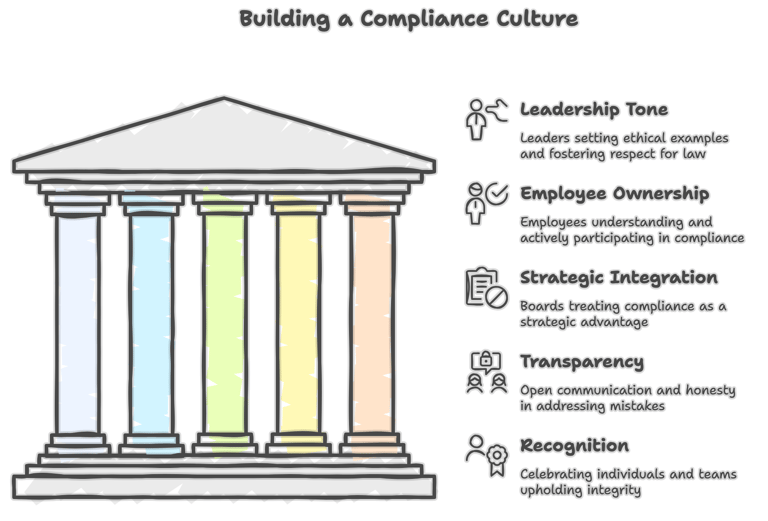
Compliance cannot live in a department; it must breathe in the culture. The moment it becomes “someone else’s job,” the organization is already exposed.
Here’s how true compliance culture grows:
Leaders Set the Tone: When leaders treat law with respect — not fear — they send a message louder than any policy document. Every ethical decision at the top trickles down as a cultural norm.
Employees Feel Ownership: Compliance shouldn’t be a burden. When employees understand why something is required, they become active participants, not passive followers.
Boards Integrate Compliance with Strategy: Governance is no longer about oversight — it’s about foresight. Boards that treat compliance as a strategic advantage often find investors and regulators more aligned with them.
Transparency Becomes Habit: Mistakes happen. The maturity of an organisation lies in how honestly it addresses them. Open communication turns compliance from fear to trust.
Celebrate Compliance Champions: In this organisation, employees were treated as the ears and eyes of management—trusted partners in safeguarding ethics and integrity. They were encouraged and rewarded for identifying non-compliances or potential risks before they became issues. This approach transformed compliance from a policing function into a shared responsibility.
Recognising individuals and teams who uphold integrity, even when it’s inconvenient, sends a powerful message: doing the right thing matters here. After all, what gets celebrated gets repeated—and when ethical behaviour is celebrated, it becomes culture.
When compliance becomes culture, it transforms from paperwork to purpose.
It’s not about following the law because we must — it’s about honouring it because we believe in it.
That’s when organisations truly earn the license to operate — not from regulators, but from society itself.
Please share your views and experiences.
#CorporateGovernance,#ComplianceCulture,#EthicalLeadership,#BusinessIntegrity,
#RiskManagement,#WorkplaceEthics