Digital HR Is Killing the Human Touch — Unless We Do It Right
10/14/20255 min read
My post content
Digital HR Is Killing the Human Touch — Unless We Do It Right
HR promised to become smarter with digital tools — faster hiring, smoother onboarding, predictive analytics. But here’s the paradox: the more we digitize HR, the more employees complain about losing human connection. Could technology meant to empower people actually be alienating them?
According to Deloitte (2024), 74% of organizations are actively digitalizing their HR functions. 92% of CHROs say technology has improved HR efficiency — yet 61% admit it has reduced genuine human interaction (PwC HR Tech Survey, 2023).
This shift has made HR faster and more efficient — but also, for many employees, more distant.
The Digital Dilemma in HR
In the past two decades, Human Resources has experienced a profound transformation. From filing cabinets and payroll registers to cloud-based HRIS platforms, AI-driven recruitment, and people analytics dashboards, today’s HR leader has access to a digital arsenal unimaginable in the 1980s and 1990s.
And yet, in conversations with employees, managers, and even senior leaders, one common concern emerges: “It feels like HR doesn’t talk to us anymore — only systems do.”
Digital HR is not inherently the enemy. In fact, digitisation has solved many longstanding inefficiencies:
Faster recruitment cycles with automated sourcing and AI screening.
Better compliance through integrated statutory and labour law modules.
Scalable learning via e-learning platforms and gamified training.
Real-time data for decision-making through HR analytics.
But if left unchecked, these same tools risk stripping away the empathy, warmth, and trust that lie at the heart of the employee–employer relationship. For example, auto generated mail congratulating employee for his achievement. A pat on the back is 100 times better than a nicely drafted auto-generated mail.
The Human Touch: Why It Still Matters
No matter how advanced technology becomes, employees don’t join or stay in a company for an algorithm. People stay when they feel respected, valued and appreciated.
Yet 58% of employees feel HR has become less personal (Gallup, 2023), and 47% feel like “a number, not a person” (Qualtrics, 2024).
Consider this:
An AI chatbot can answer leave policy queries 24/7 — but can it understand the tone of urgency in an employee’s voice when they are requesting sudden bereavement leave?
Analytics can flag a “flight risk” employee — but it takes a real conversation to uncover that the reason is a sick parent, a stressful manager, or a lack of career visibility.
A digital onboarding module can walk new hires through compliance forms — but only human mentorship can help them feel welcome and truly integrated into the culture.
The risk is clear: If HR leaders allow systems to replace relationships, they will win efficiency but lose trust.
Where Digital HR Goes Wrong
Let’s break down three common mistakes companies make in their digital HR journey:
1. Automation without Empathy
Chatbots and self-service portals often become walls instead of bridges. Employees sense that the company values cost-saving over connection.
2. Data without Dialogue
Predictive analytics gives excellent dashboards, but HR teams sometimes skip the critical next step — talking to people to validate insights.
3. Processes over People
When digitization focuses only on compliance or transactions, HR risks being perceived as “system managers” rather than “people champions.”
The end result? Employees feel they are managed by machines, not supported by humans.
Doing Digital HR Right
So, how can organisations enjoy the benefits of digital HR without losing the human essence? Here are six strategies drawn from both experience and observation:
1. Humanise Every Touchpoint
o Instead of letting chatbots end conversations with “Query closed,” program them to say, “Would you like me to connect you with an HR partner?”
o Blend digital FAQ systems with escalation paths to live humans.
2. Balance High-Tech with High-Touch
o Use AI to shortlist candidates, but ensure the first conversation they have is with a real recruiter who can talk about culture and aspirations.
o Run e-learning programs, but complement them with mentoring circles, group discussions, and feedback sessions.
3. Train HR to Be Storytellers, Not System Operators
The future HR professional must be comfortable explaining data insights through stories. For example: “Our attrition has spiked 12% in R&D — but behind the numbers are mid-career employees struggling with recognition.”
4.Design for Empathy in Technology
Digital platforms can be customized. Instead of sterile system-generated messages (“Your leave is rejected”), why not: “We’re sorry your leave request couldn’t be approved this time. Please reach out if you’d like to discuss options.”
5.Measure Trust, Not Just Transactions
HR dashboards usually focus on efficiency metrics: time-to-hire, training completion rates, payroll accuracy. Add trust metrics — employee sentiment, manager–employee relationship scores, psychological safety indicators and mental health of employees
6.Keep “Open Door HR” Alive — Virtually
With hybrid work, physical open doors may not exist. But HR leaders can create virtual “office hours,” where employees know they can log in and talk to a real human, unfiltered.
Case in Point: A Balanced Model
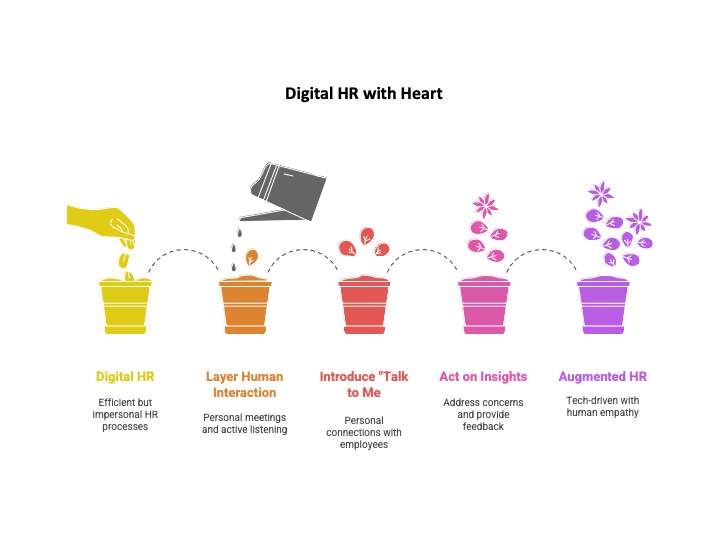
At a large manufacturing group where I worked, we implemented an HRIS to serve a vast employee base. Initially, people appreciated the speed and efficiency, but soon concerns surfaced — employees felt HR was becoming invisible. The answer wasn’t to abandon the system, but to layer it with genuine human interaction. This meant holding personal meetings, listening to employees’ issues from their perspective, anticipating fears when introducing new policies, and even piloting schemes so adjustments could be made without ego clashes.
Our employee satisfaction surveys, though useful, eventually became routine and uninspiring. To address this, we introduced an initiative called “Talk to Me.” Under this program, HR representatives personally connected with every employee at least once a year in a casual, conversational setting. The insights gathered were analysed, and whenever genuine concerns emerged, we acted on them. For issues that couldn’t be resolved, we ensured employees received honest and respectful feedback.
Within just a year, employee satisfaction scores improved significantly. The experience reinforced a simple truth: digital efficiency and human empathy are not mutually exclusive — they must co-exist.
The Future of HR: Tech + Touch
The HR of the future is neither fully automated nor purely human-driven. It is augmented HR — where digital tools remove friction, bring accuracy and unbiased approach, and human empathy builds trust.
Imagine this:
An AI engine alerts HR that a high-performing employee may be disengaged.
The HR partner immediately schedules a face-to-face check-in, not a survey.
The outcome is not just retention of an employee, but strengthening of the employee’s faith in the organisation.
That’s the true promise of Digital HR when done right.
Final Thought
Digital HR is not killing the human touch by design — it’s killing it by default, when leaders forget that technology is only a tool, not a relationship.
The organisations that thrive in the future will be those that marry the speed of digital with the soul of human connection.
And the results speak for themselves: organisations with high employee connect outperform others by 186% in total shareholder returns (Great Place to Work, 2023).
👉 What’s your take? Has digital HR enhanced or diluted the human connection in your workplace?
👉 Share your thoughts or experiences in the comments — I’d love to hear real-world stories.
#DigitalHR #HRTech #HRTransformation #FutureOfWork #PeopleAnalytics#EmpathyAtWork